
What should I do first in Resonance: A Plague Tale Legacy?
Pick a difficulty, learn yellow parry vs red dodge, grab Resonance Points on your path, and open Charm chests. This beginner guide is that loop — not a full 14-chapter walkthrough.

This Resonance: A Plague Tale Legacy beginner guide is the first-hours route for Resonance: A Plague Tale Legacy from Asobo Studio, published by Focus Entertainment: pick a difficulty, learn yellow parry vs red dodge, and start banking Resonance Points toward the 165 needed for the full skill tree in a single playthrough. You play Sophia on Crete's Minotaur's Island in 1334, with timeline shifts into Theseus. Verified August 28, 2026 · Steam.
| Fact | Detail |
|---|---|
| Platform | Steam · PS5 · Xbox Series X|S · Game Pass Day One |
| Genre | Action-adventure · melee · light puzzles |
| Mode | Single-player |
| Price | ~$49.99 Standard · Heritage Pack pre-order extras |
| Release | Released August 27, 2026 |
| Developer / Publisher | Asobo Studio / Focus Entertainment |
| Steam | App 2713000 |
| Player | Sophia — plunderer · melee · grapnel · notebook |
| Timeline | Medieval Sophia ↔ Minoan Theseus |
| Combat | Yellow parry · red dodge · kick · critical / finisher · grapnel |
| Skills | 6 branches · ~200 Resonance Points in world · 165 for full tree |
| Chapters | 14 chapters · chapter select · no NG+ |
| Puzzles | Minoan Sphere light split / mirrors · optional Leni hints |
Difficulty is the first real decision in this Resonance: A Plague Tale Legacy beginner guide. The ladder runs from Narrative up to Nightmare. Narrative can auto-parry and auto-dodge, which is the right pick if you care more about story and island exploration than manual timing. Higher steps expect you to read telegraphs yourself and punish mistimed windows harder; Nightmare raises enemy aggression and resistance.
| If you want… | Start on | Why |
|---|---|---|
| Story first, low fight friction | Narrative | Assisted parry/dodge keeps chapters moving |
| Learn yellow/red yourself | Standard / mid tiers | Manual reads without Nightmare pressure |
| Strict melee practice | High / Nightmare | More aggression and resistance — drill after you know telegraphs |
| Trophy / achievement comfort | Any, then raise | You can change difficulty later; combat habits transfer |
Narrative still teaches the same yellow/red language and the same kick / grapnel tools. It simply softens the timing tax so you can focus on notebook clues, light puzzles, and collectible pressure. If you later want stricter combat, raise the dial — the combat page is written for manual reads.
Do not open on Nightmare just to "play it properly." Learn kick against blockers, grapnel pulls on clustered foes, and the stagger-into-critical loop first. Nightmare is a second pass for players who already own the telegraph language.
Once difficulty is set, the next question is what to do with the opening hours before the skill tree starts competing for every shiny pickup.
Treat the opening as a systems tutorial, not a lore dump. Sophia's loop is explore → fight → puzzle → collect → spend. You do not need prior Plague Tale games; this is a standalone prequel set fifteen years before Requiem.
Resonance leans into melee rhythm and grapnel disruption more than rat-swarm stealth. Stealth habits from older games still help for positioning, but standing still waiting for a perfect backstab is the wrong beginner default. Keep moving, read the telegraph, then decide parry, dodge, kick, or pull.
After you finish chapters, chapter select can help you reclaim fixed collectibles. It does not let you farm Resonance Points across replays for the full 165 unlock. Plan the skill-tree goal as one continuous run — details live on resonance points.
Before you spend those points, you need the telegraph rule that every early fight is teaching.
Melee is a color language. Yellow telegraphs can be parried (tighter window, builds stagger, opens counters). Red telegraphs are unblockable for most of the campaign — dodge them. Kick breaks defensive stances. Criticals / finishers land when stagger or recovery says so. Grapnel adds stagger and yank utility.

| Signal | Do this | Do not |
|---|---|---|
| Yellow flash | Parry on timing; build stagger | Panic-dodge every yellow and lose counter windows |
| Red flash | Dodge — default rule for most of the game | Parry red until a skill mastery explicitly allows it |
| Enemy blocking | Kick to break, then resume pressure | Whittle the guard with empty swings |
| Staggered foe | Critical / finisher / dagger window | Walk away and reset the gauge for free |
| Cluster / archer | Grapnel yank, then ready parry/dodge on arrival | Grapnel mid-red without a dodge plan |
Parry is higher reward and tighter timing; dodge is safer spacing but steps you out of immediate stab range. Both matter. The hard rule for beginners: red means dodge until a mastery (often under Aegean Deflect-style branches) says otherwise. Full drill tables belong on combat.
Theseus shares the yellow/red language but not Sophia's full grapnel kit. Expect focus-style pressure without the same pull-in crutch. Stay extra disciplined on red telegraphs in those beats.
With telegraphs readable, the next beginner trap is spending Resonance Points like infinite currency.
Matched by build plan, shared topics, and guide progression — not random related links.
There are about 200 Resonance Points in a full clear and 165 are required to unlock the entire tree (six branches with escalating costs). Masteries on each skill have their own fixed costs. You can respec in the skills menu, but you still must collect enough points in one playthrough for the completionist unlock.
| Early priority | Why | Defer |
|---|---|---|
| One defensive mastery path you will actually use | Survivability compounds every chapter | Spreading one point into every branch |
| Parry-support if you like yellow reads | Aegean Deflect-style upgrades amplify stagger returns | Offensive-only trees before you can live |
| Crowd tools if fights already feel messy | Echo / kick masteries help groups | Dumping points before you feel the kit |
| Respec after a boss teaches a lesson | Refunds are allowed — use them | Hoarding points "for later" while dying now |
Community-logged pricing climbs as you unlock more main skills (often +5 per unlock), while individual masteries sit on a flatter cost. Exact per-node numbers belong on skills; the beginner rule is simpler: buy what fixes the fight you are failing this chapter, then respec if the next chapter asks for a different answer.
Resonance Points drop from some encounters and sit as pickups in the world. If you are aiming at the full tree or the related achievement, treat every sparkle as budget. Skipping a side alcove on chapter three is how people miss the 165 line later.
Points are only half of the island's checklist — Blades and Charms change how those points feel in your hands.
Exploration pays four parallel tracks: Resonance Points, Blades, Charms, and Artefacts. Artefacts are mostly completionist lore. Charms and Blades change combat immediately.
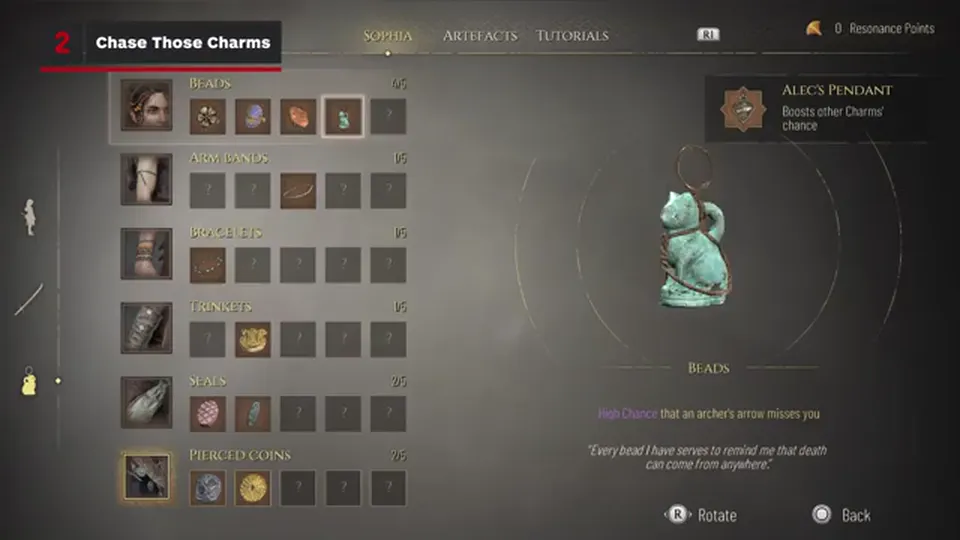
| Pickup | Beginner rule |
|---|---|
| Charms (~30) | Auto-equip / always-on bonuses that stack by type — open every small chest you pass |
| Blades (~8, + Heritage) | You choose which Blade is active; each adds a technique feel — swap when a fight asks for it |
| Artefacts (~37) | Lore and completion — safe to backlog if you are mid-combat |
| Notebook / eye marks | Puzzle memory and standing spots for light-orb angles |
| Leni hints | Optional — use when stuck; they do not replace Resonance Point collection |
Charm types (beads, bracelets, and related families) apply as you find them — there is no separate "equip screen" tax for the basic set. Blades are different: pick the sword that matches how you want to press, then keep exploring tombs marked by sword monuments when you see them. Deep lists sit on charms and blades.
The Minoan Sphere splits and redirects light. When you are stuck, open the notebook for symbols and look for ground eye marks that suggest a viewing angle. Optional Leni hints exist so you do not soft-lock a chapter. Pattern library: puzzles.
If the opening still feels wasted, it is usually one of the process errors below — not a missing legendary name.
Scan this before the next chapter gate. It is the executable checklist this Resonance: A Plague Tale Legacy beginner guide is for — situation to action, not another loop recap.
| Mistake | Fix |
|---|---|
| Parrying red telegraphs on default kits | Dodge red until a mastery says you can parry them |
| Ignoring kick on blockers | Kick first, then resume yellow pressure |
| Skipping Resonance Point pickups | Grab sparkles in the same pass as the story path |
| Assuming chapter select farms skill points | Fixed collectibles yes; 165-point goal needs one run |
| Saving every point "for the perfect build" | Buy the fix for this chapter, respec later |
| Treating this like stealth-only Plague Tale | Learn melee rhythm; stealth is optional positioning |
| Never opening Charm chests | Stacking passives are free power |
| Skipping notebook on light puzzles | Symbols and eye marks exist for a reason |
| Expecting older series trophy lists to match | This is Resonance — use this site's trophy page |
| Grapnel yank with no follow-up plan | Pull, then be ready to dodge/parry on arrival |
At every new area: note yellow vs red, take the Resonance Points on your path, and open Charm chests before you leave. That single pass prevents the three biggest beginner holes — telegraph deaths, point drought, and unused passives.
When that habit is automatic, go drill telegraphs on the combat page, then skim tips for missables before you push deeper into the 14-chapter route.
Pick a difficulty, learn yellow parry vs red dodge, grab Resonance Points on your path, and open Charm chests. This beginner guide is that loop — not a full 14-chapter walkthrough.
Narrative if you want assisted parry/dodge and story pacing. Mid tiers if you want to learn telegraphs yourself. Nightmare can wait until the color language is automatic.
No. Resonance is a standalone prequel. Series knowledge adds context; it is not required to play.
No. Yellow can be parried; red must be dodged for most of the game unless a skill mastery explicitly changes that rule.
Not for the full 165-point tree goal. Plan a single playthrough for that unlock. Chapter select still helps with fixed collectibles.
No. This is a premium Steam / console release. There is no /codes page on this site.
Community and FAQ ranges cluster around ~15–20 hours for a story pass; 100% collection runs longer. Exact time varies with difficulty and puzzle pace.
Drill telegraphs on combat, then tips for missables. Story route: walkthrough.
August 28, 2026
Matched by build plan, shared topics, and guide progression — not random related links.